

Return on Investment, or ROI, is one of the first numbers traders check when they want to understand how well a crypto position performed. Every market swing carries a reaction, but ROI brings the entire movement back to a single percentage.
This helps you see how the result compares with the money you committed at the beginning. When you understand ROI correctly, you read your profits and losses with more clarity, and you judge your trades with a steadier mind.
A crypto position can move fast, and the market can shift in surprising ways. You may buy at one moment and exit at another, and the gap between those moments creates the number that shapes ROI. Once you understand how to read that number, you understand the real strength of your trade.
What ROI Means in Crypto
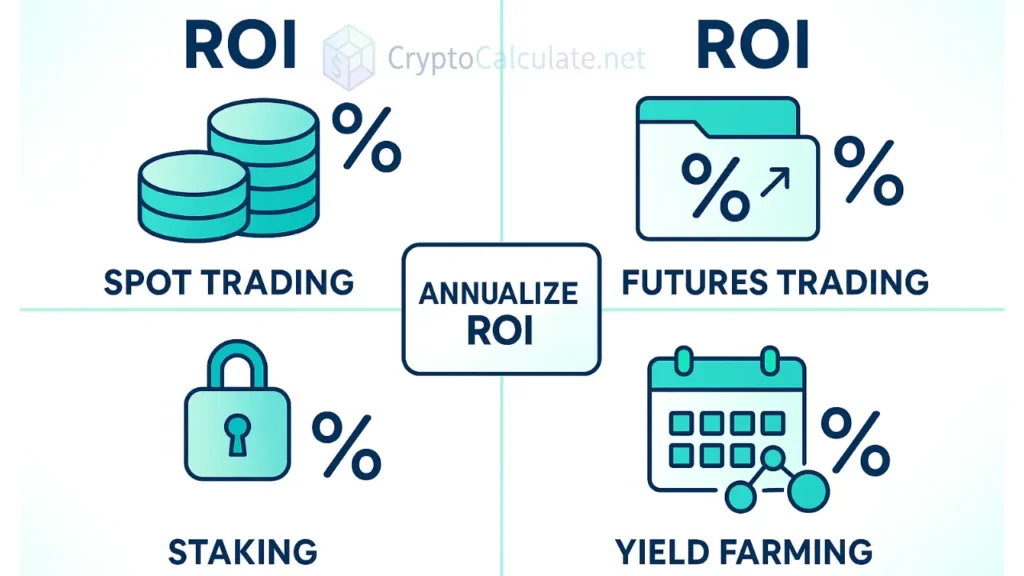
ROI measures how much you gained or lost compared with your starting amount. You will work with a percentage, so the number fits short positions, long positions, staking, NFTs, or any asset you hold.
The result is always a comparison between the entry point and the current or exit point. If you put 100 dollars into a coin and exit with 150 dollars, the ROI number shows a positive return. If you exit with 80 dollars, the percentage turns negative. The entire idea depends on understanding what you put in and what you have at the end.
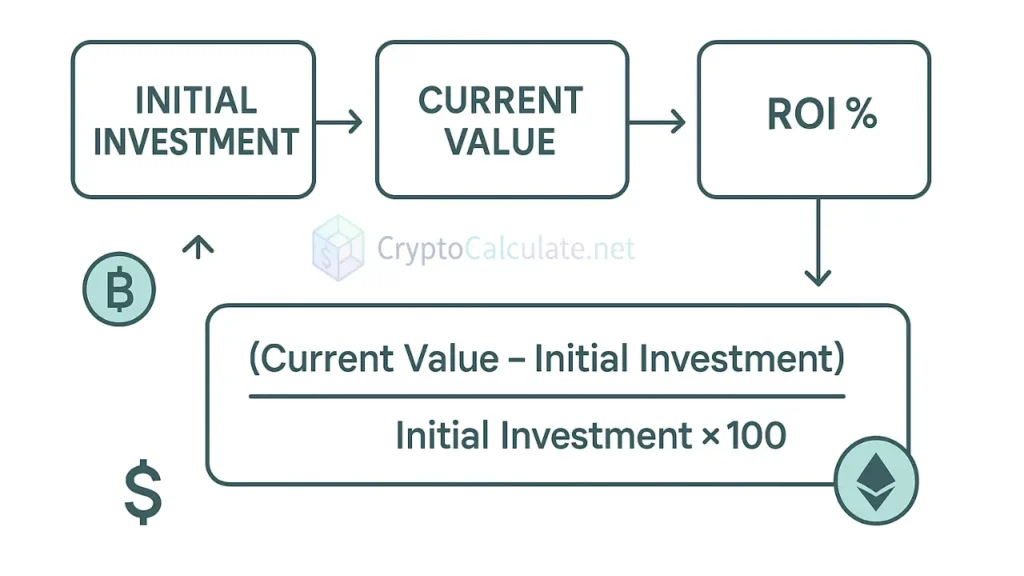
ROI has a simple structure.
ROI = (Current Value − Initial Investment) ÷ Initial Investment × 100
This formula sits at the center of the entire concept.
A Basic ROI Example
Here is a straightforward case. A trader puts 500 dollars into Bitcoin. After twelve months the value rises to 750 dollars.
ROI = (750 − 500) ÷ 500 × 100 = 50%
This number shows that the position grew fifty percent from the original cost. You can read the gain instantly without checking any candle or chart pattern.
Why ROI Matters in Crypto
A market as fast as crypto can move your emotions quickly. ROI gives you a calm reference point. You can review your trade in a grounded way because the number reflects the relationship between your cost and your return.
It becomes easier to compare one asset with another because the calculation stays the same across all positions. You can also compare your results with stocks, real estate, or savings products since ROI is universal.
A clean ROI number removes confusion when you manage several coins at once. You get a steady view of performance because the result sits in one clear percentage rather than scattered values.
How to Calculate ROI Step by Step
A few steps give you a complete picture of your return.
Step 1: Find Your Initial Investment
Your initial investment includes everything you spent on the trade. If you bought Bitcoin worth 1000 dollars and paid a 20 dollar fee, your initial investment becomes 1020 dollars. Some traders skip the fee and misread ROI, so this step matters more than it seems.
Step 2: Find the Current Value
You can check the live price on an exchange or an app. If you bought 0.05 BTC at 20000 dollars and the current price sits at 30000 dollars, the calculation becomes:
Current value = 0.05 × 30000 = 1500 dollars
This number tells you the real worth of the position today.
Step 3: Apply the ROI Formula
Insert the numbers into the formula.
ROI = (1500 − 1020) ÷ 1020 × 100 = 47%
You now understand your return.
Step 4: Consider How Long You Held the Asset
Time matters. A short holding period with a strong gain is different from a long holding period with the same gain. This is where annualized ROI enters the picture. Annualized ROI spreads the return across the number of years and gives you a more consistent view.
Annualized ROI = [(Final Value ÷ Initial Value) ^ (1 ÷ Years Held)] − 1 × 100
It helps you compare a one year trade with a five year trade, or a six month trade with a two year trade, without confusion.
ROI Table with Example Coins
This table shows how ROI looks when you add holding time.
| Coin | Initial Investment | Current Value | ROI | Holding Period | Annualized ROI |
|---|---|---|---|---|---|
| Bitcoin | 1020 | 1500 | 47% | 1 year | 47% |
| Ethereum | 800 | 1120 | 40% | 2 years | 18% |
| Dogecoin | 200 | 260 | 30% | 6 months | 60% |
This comparison makes it easier to see how time changes the real meaning of the return.
If you want to make sense of your entries, the Crypto Gains Calculator on CryptoCalculate.net gives you a steady view.
Short Term ROI vs Long Term ROI
Short term traders use ROI to judge fast turnarounds. A two day or two week return reflects how quickly a trade moved. Long term investors care more about how their position grew across months or years.
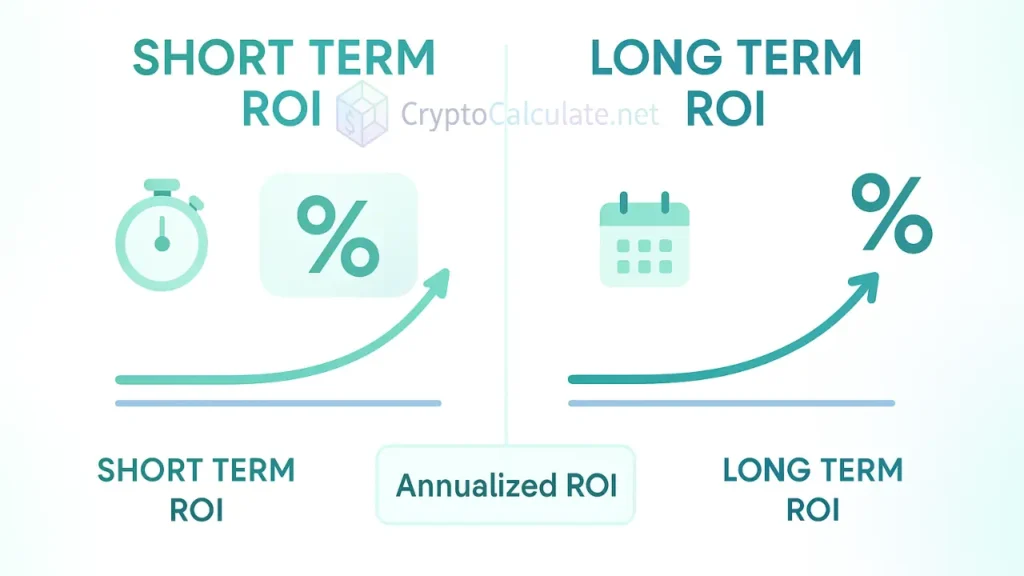
The same ROI number has different meaning in both scenarios. A twenty percent return in two days signals one type of result. A twenty percent return over five years signals another. Once you look at ROI with holding time in mind, the picture becomes clearer.
Elements That Shape ROI in Crypto
A position does not move in isolation. Many factors influence your final number.
Here are a few that matter:
- Market changes that shift price rapidly
- Trading fees on exchanges such as Binance or Coinbase
- Tax rules in your region
- Exchange spreads that raise or lower the effective price
- Currency conversion when your account uses a different base currency
You get a stronger picture when all these items are included. If you rely only on the price difference, the result may appear higher or lower than the real number.
ROI Compared with Other Metrics
ROI gives a broad view, but other metrics build more depth.
Here are a few common ones:
- Annualized ROI for time based comparison
- Net ROI after counting fees and taxes
- Risk adjusted ROI when you compare return with volatility
You can start with regular ROI and then check the other metrics when you want a deeper review.
Real Case Study Example
A real case helps you see how ROI plays out. A trader buys Solana for 40 dollars and invests 400 dollars for 10 SOL. When Solana reaches 100 dollars, the position becomes worth 1000 dollars.
ROI = (1000 − 400) ÷ 400 × 100 = 150%
The number seems strong. After checking fees and tax impact, the real ROI becomes closer to 110 percent. This shows how important it is to include all elements rather than only the final price jump.
Tools You Can Use to Track ROI
Many tools help you calculate ROI without manual effort. You can use them daily or weekly to understand how your portfolio moves.
- CoinMarketCap ROI calculator
- Portfolio apps such as CoinStats and Delta
- Exchange apps on Binance, Kraken, or Coinbase
- Google Sheets or Excel
- The ROI tools on CryptoCalculate.net
These tools give a steady rhythm to your tracking so you read your numbers with more confidence.
Common Mistakes in ROI Calculation
A few errors can distort ROI and give the wrong impression.
Common mistakes include:
- Leaving fees and taxes out of the calculation
- Forgetting the impact of holding time
- Misreading ROI due to currency differences
- Reviewing ROI during sudden spikes without context
- Counting unrealized returns as final results
One small mistake many traders make is assuming ROI becomes final before selling. A return becomes real only when you exit the trade.
ROI in Different Crypto Strategies
Crypto strategies reveal ROI in different forms. You can compare them to understand how this number shifts across market styles.
ROI in Spot Trading
Spot ROI is direct. You buy at one point and exit at another. The difference between the two numbers shapes the return after fees. You get a clear comparison between entry and exit.
ROI in Futures Trading
Futures ROI works on margin, not on the full asset amount. This creates a return that can appear larger compared with the cost. You should check both potential gain and potential loss because the margin structure shifts rapidly.
ROI in Staking
Staking rewards contribute to your return. You can add the reward value to your current amount before calculating ROI. This helps you see the real picture of a long term position.
ROI in Yield Farming
Yield farming returns move with APR or APY. The blend of returns changes across time, so ROI must include the rate and the reward structure. A short term ROI and an annualized ROI create a more complete picture.
FAQs
What is considered a good ROI in crypto
A good ROI depends on your holding time and your risk level. A short term return may look strong, while a slow return across several years may appear weaker. Context matters.
Can ROI be negative
Yes. If the current value is lower than the initial amount, the return becomes negative.
Do staking rewards count in ROI
Yes. Rewards add to your current value and change the ROI number.
Can you compare ROI across different markets
Yes. ROI works across crypto, stocks, and other markets, so you can compare returns fairly.
Checklist for You
Here is a quick review you can follow each time.
- Count fees and taxes inside your initial cost
- Adjust your result for holding time
- Compare the number with other assets
- Track ROI with apps or sheets
- Check if your return is realized or unrealized
- Use a single currency during calculation
A steady ROI calculation gives you a stronger understanding of your crypto trades and creates a better foundation for every future entry.