

Crypto staking sits at the center of passive income conversations in the trading world. The idea is fairly direct. You lock your coins, and the network gives you new coins as a reward for supporting it.
Many users understand the concept, but the confusion usually starts when the reward calculation comes into the picture. It feels even more confusing when different platforms show different percentages. A clear method brings a lot more confidence, and that is the focus of this guide.
The point is simple here. Staking rewards do not stay constant. Network activity, validator strength, payout frequency, and the time you keep your funds locked shape the final result. Once you see how each part fits into the formula, the process becomes easier to track and understand over time.
Note: For a quick and clear breakdown of your trade results, the Crypto Profit Calculator on our website gives you accurate numbers instantly.
What Is Crypto Staking
Crypto staking works like a participation method for Proof of Stake blockchains. You lock tokens inside a supported wallet or platform, and the network distributes new tokens to you for helping validate blocks. Ethereum, Solana, Cardano, Cosmos, and Tezos are well known for this.
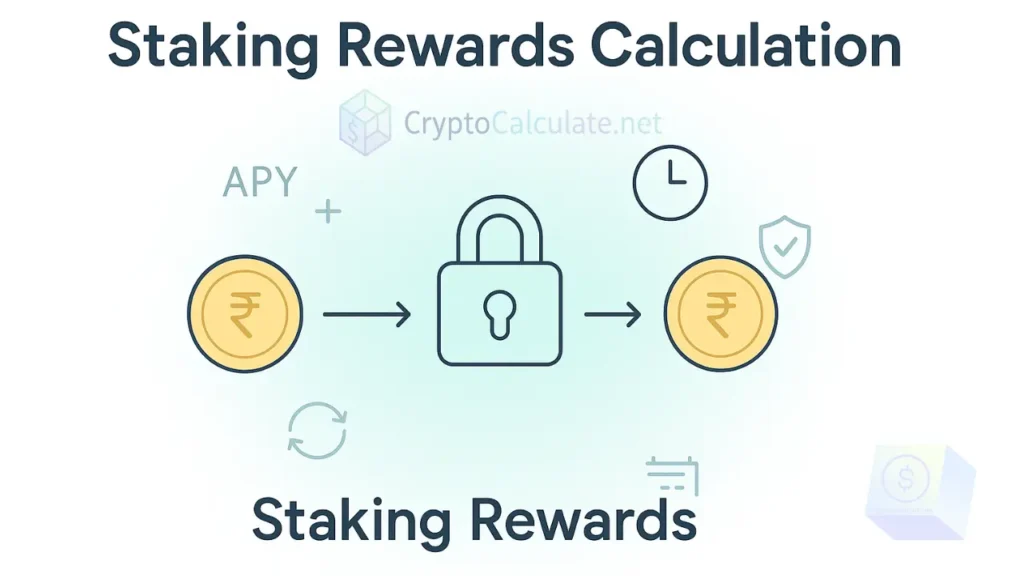
You must have noticed that staking platforms show returns as APY or APR. These numbers look clear at first glance, but you cannot know your actual outcome until you calculate it based on your own amount and duration.
Staking also works differently from token to token. Some chains distribute rewards daily, some follow a weekly pattern, and a few add your rewards back to the principal automatically. Reading the payout rules before you start keeps things under control.
Key Factors That Shape Staking Rewards
Just check this once because it forms the backbone of your calculation.
| Factor | Description |
|---|---|
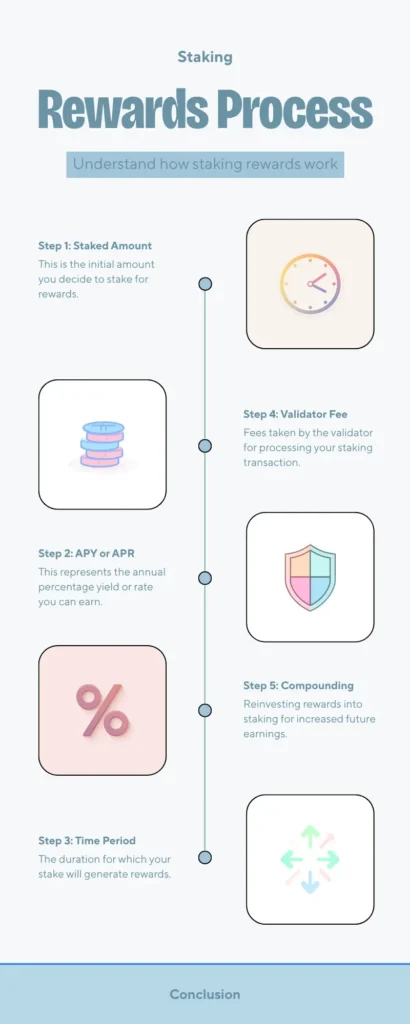
| Staked Amount | Total number of tokens you lock |
| APY or APR | Annual return rate with or without compounding |
| Staking Duration | How long your funds remain locked |
| Payout Frequency | How often rewards are sent to you |
| Validator Commission | Portion taken by the validator from your rewards |
A few points guide the final number:
- Size of your staked amount
- APY or APR shown by the network
- The time you keep your funds locked
- Frequency of reward payouts
- Validator fee percentage
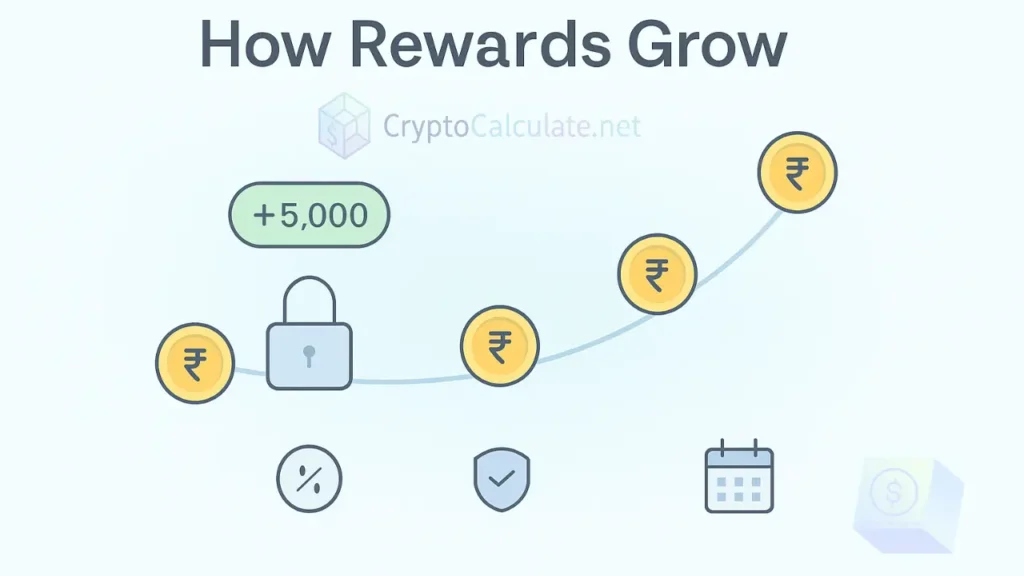
In addition to this, some platforms support auto restaking. The reward gets added back into your balance and starts earning from the next cycle. That is how compounding grows your long term return.
Step 1: Identify APY or APR
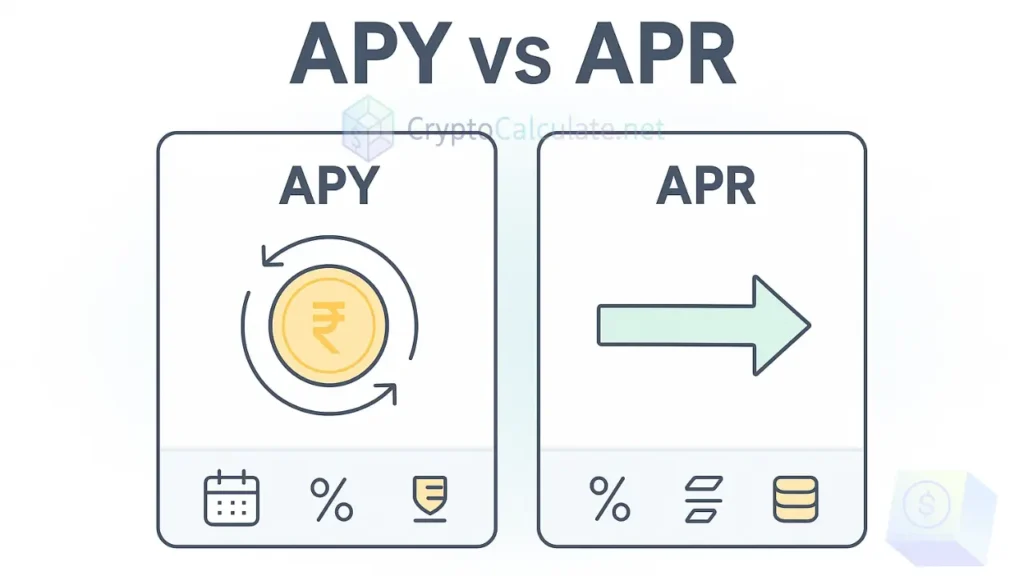
APY means Annual Percentage Yield. APR means Annual Percentage Rate. APY includes compounding inside the year, while APR keeps the reward calculation straight without adding it back. You see a higher outcome with APY because every payout increases the base amount.
Example
- Staked amount: 1000 tokens
- APY: 10 percent
- Expected one year total: close to 1100 tokens if compounded monthly
Staking wallets like Ledger Live, Keplr, and Phantom present both APY and APR on the same screen, which makes it easier to compare.
Step 2: Set Your Time Frame
What I usually do is check three timelines. One month, three months, and six months. That creates a clear picture before committing to a staking period. Some networks do not lock your funds at all. Solana lets you freely stake and unstake with a short waiting time. Cosmos and Tezos use unbonding periods that last a few days.
If APY is 12 percent, the monthly reward stays around one percent. So a user with 1000 tokens earns around 10 tokens for a month. Dividing the APY into daily reward by using 365 also works well when planning inside a spreadsheet.
Step 3: Apply Validator Commission
Do not skip this step because it changes the final number. Validators collect a small fee from your reward to maintain infrastructure and uptime. A common rate sits between two percent and ten percent. Some high performance validators may go slightly higher.
Example
- Tokens earned: 10
- Validator fee: 5 percent
- Fee amount: 0.5
- Net reward: 9.5
The thing is, validator efficiency shapes long term returns. Consistent uptime and low commissions increase your reward.
Step 4: Consider Compounding
Sometimes this works better, especially if your staking platform compounds automatically. The next cycle reward becomes slightly higher because the base amount increased.
- Example with compounding
- Month 1 reward: 9.5
- Month 2 reward: calculated on 1009.5
- Month 3 reward: calculated on the new amount
Manual restaking works too. Some platforms display a restake button, but gas fees may apply depending on the chain.
Step 5: Track Your Total Reward
A clean record removes confusion. Many users track it inside a Google Sheet. A few traders use dashboards like Staking Rewards for a structured view. The record should include:
- Initial stake
- Daily or monthly reward
- Validator fee
- Net reward
- Final balance after the chosen period
Most students I know do this in a spreadsheet because it keeps everything visible in one place.
Example: Real Calculation
A Polkadot example brings more clarity.
- Staked amount: 200 DOT
- APY: 15 percent
- Monthly rate: 1.25 percent
- Reward per month: 2.5 DOT
- Validator fee: 5 percent
- Fee amount: 0.125 DOT
- Net reward: 2.375 DOT
If you let it compound for six months, the result grows slightly beyond a flat multiplication because each payout increases the base.
In my case this worked on Binance where rewards updated daily. Exchange staking numbers may differ from native staking because each exchange uses its own internal structure.
When Do Taxes Apply
The thing is, staking rewards are treated as income in many regions. The value at the time you receive the reward becomes part of taxable income. In the US and UK, it gets added to your income bracket. India treats it similarly under income rules.
Do not take it lightly because steady rewards can increase your tax load. Keeping monthly statements or screenshots helps under any tax system. Tools like CoinTracker and Koinly simplify this.
Mistakes To Avoid
One small mistake many people make is assuming that staking rewards stay fixed. They shift based on network conditions. Validators also vary in performance. If a validator goes offline or gets penalized, it affects your reward or even your principal.
Be careful at this step and verify validator uptime, fee rate, and reputation. A few users also forget to claim rewards when manual claiming is required. Those rewards sit there without growing.
Final Checklist
- Check the APY or APR before you start
- Pick a validator with good uptime and a low fee
- Note the lock period or unbonding period
- Calculate your reward monthly or weekly
- Track values using sheets or dashboards
- Keep tax records updated
- Avoid untested tokens with weak validator support
- Monitor your validator once in a while
- Decide your reinvest or withdrawal plan
- Export monthly reports if possible
So finally, staking rewards feel much clearer once you work with the actual numbers. The outcome becomes steady when you track the small parts and follow a consistent routine. A calm approach goes a long way in staking because the power comes from time, patience, and accurate calculation.
FAQs
How much can someone earn from staking
The return stays connected to APY or APR, the amount staked, payout frequency, the validator fee, and the time the funds remain locked. A larger stake and a steady validator create a smoother reward pattern. Market conditions also shift the final outcome, so the projected number should always be treated as an estimate.
What is considered a good APY for staking
A rate above five percent works well for most large networks because it shows steady participation without extreme risk. SOL, ADA, DOT, and ATOM usually sit in the five to twenty percent range, and this gives a realistic picture to most users. Smaller projects may show higher numbers, but the long term reliability of those networks may not stay the same.
Can someone lose money by staking
A loss can appear when the token price drops sharply or when a validator gets penalized. The value of the token moves every day, and that movement matters more than the reward itself. A validator issue can reduce the reward, but price volatility usually creates the bigger impact.
Which platform works well for staking
Wallets like Ledger Live, Phantom, Keplr, Trust Wallet, Daedalus, and Binance follow a clear structure for staking and show rewards in a readable format. Native wallets for each blockchain usually keep the strongest link to validator data, while exchanges place more focus on simplicity and quick access.
Are staking rewards guaranteed
Reward numbers change because networks adjust emission rates, inflation rules, and validator performance. The rate you see in the app works as an estimate and not a locked return. Network activity plays a quiet but major role in this.
Can someone unstake at any time
Each blockchain follows its own unbonding rule. Cosmos uses a twenty one day period. Polkadot waits twenty eight days. Solana releases funds with a shorter wait. Exchange staking may release funds faster because they handle the backend on their own structure.
Is it better to stake on chain or through an exchange
On chain staking gives stronger control over validator selection and fee structure. Exchange staking keeps the process smoother for beginners. The choice depends on personal risk comfort and the level of control someone wants.
Do staking rewards get taxed
Many countries classify staking rewards as income on the date the reward is credited. The value at that time needs to be recorded for tax filing. A monthly record removes confusion later and keeps the calculation grounded.