

When you build positions in crypto, you track entry prices, market moves, and portfolio value. You rarely see traders talk about the real number that protects their capital. That number is your break even price.
It tells you the exact level where you recover every cost you spent to build the position. Once the coin touches that point, you are neither gaining nor losing. You reach neutral ground. Many traders skip this step, but you need it if you want cleaner exits, safer sell orders, and accurate tax reporting.

What Break Even Price Means
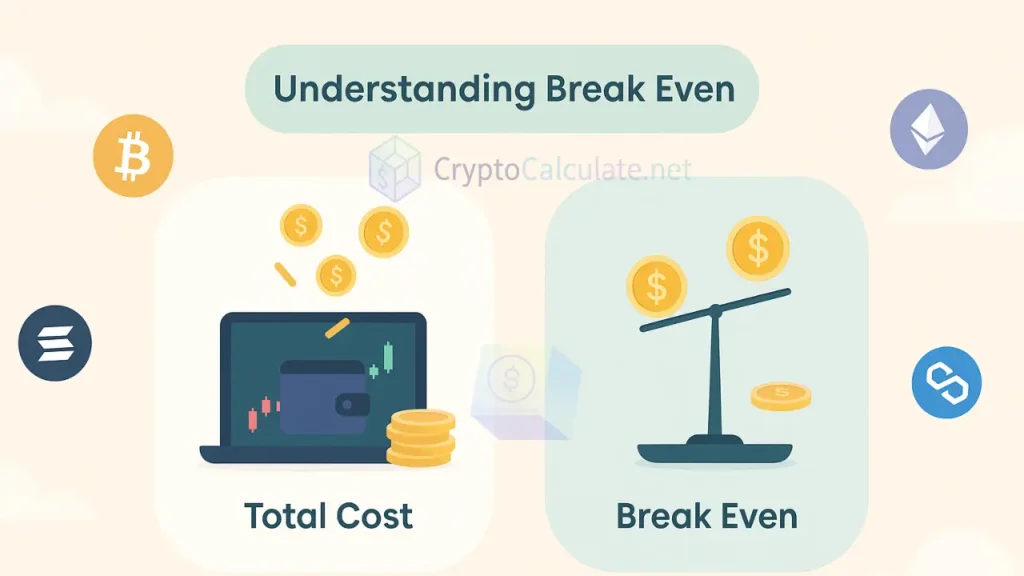
Break even price is the market price where your total cost and your total value match. It shows the minimum price at which your trade stops showing loss. It looks similar to an average buy, but it is not the same.
Your average only shows the cost of the coin without any extra elements. Your break even includes trading fees, spreads, network fees, and slippage. This pushes the number a little higher.
You can place your trade details inside the Crypto Profit Calculator on CryptoCalculate.net, since it shows your break even point in seconds and keeps everything clear when you track several coins.
Simple Example
You buy Ethereum worth 1000 dollars and pay 20 dollars in trading fees. Your total cost becomes 1020 dollars. Your break even becomes 1020 dollars divided by the number of ETH you received. If the price stays below that number, you stay in loss.
Why Break Even Matters for Crypto Traders
Break even is more than a comfort number. It plays a role in your entire trading plan.
Here is what break even helps you understand
- Your minimum exit point when you want to avoid loss
- Your stop loss and take profit levels
- Your real position cost after all hidden elements
- Your tax calculation base
- Your average slippage impact when you trade fast coins
A lot of new traders check the market price and feel they are safe. Later they add fees and see that they are still below their recovery point. This happens because break even always carries the real cost.
Step by Step: Calculating Break Even Price
Break even follows a direct structure. Once you understand the logic, you can apply it to any coin.
Step 1: Note Your Total Spend
This includes the amount you paid for the coins and the trading fee.
If you bought 2 SOL for 40 dollars each, you spent 80 dollars. Add a 2 dollar trading fee and your cost becomes 82 dollars.
Step 2: Add Extra Costs
You may pay withdrawal fees or face spread differences.
If you later spent 1 dollar network fee to move the coins, your cost becomes 83 dollars.
Step 3: Divide by Quantity
Now divide total cost by total coins.
Eighty three dollars divided by 2 equals 41.50 dollars. That amount becomes your break even per SOL.
Break Even vs Average Buy Price
Many traders confuse these two. They look similar at first glance but they behave differently.
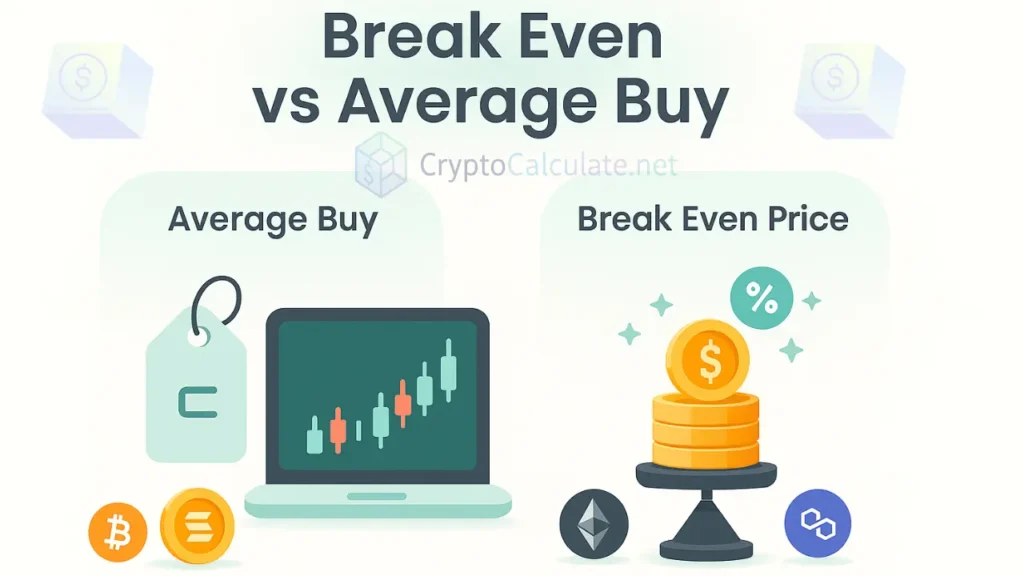
Here is the difference
- Average Buy Price includes only your coin cost.
- Break Even Price includes all extra expenses like fees, spreads, and network charges.
A Quick Example
You buy Bitcoin worth 1000 dollars at an average price of 20000 dollars per BTC. When you add your 50 dollars trading fee, your break even becomes 20500 dollars per BTC. That small jump becomes important in sideways markets where small moves matter.
Extended Example of Break Even with Mixed Tokens
Here is a deeper example that shows how break even changes across tokens.
| Coin | Quantity | Average Buy | Added Costs | Break Even |
|---|---|---|---|---|
| BTC | 0.05 | 20000 | 50 | 21000 |
| ETH | 2 | 1600 | 40 | 1620 |
| SOL | 5 | 40 | 10 | 42 |
You can see that break even stays higher than average buy every time. This happens because each trade carries small hidden elements that add to your cost.
New Example with Layer 2 Tokens
Here is another example with newer tokens that are traded more frequently.
| Coin | Quantity | Average Buy | Added Costs | Break Even |
|---|---|---|---|---|
| ARB | 40 | 1.50 | 8 | 1.70 |
| OP | 25 | 2.10 | 6 | 2.34 |
| MATIC | 30 | 0.70 | 5 | 0.86 |
These tokens move faster, so small cost differences change your break even quickly. When you buy in several rounds, your break even keeps shifting.
How Market Moves Change Your Break Even
Break even is not a fixed number. It adjusts every time you buy more coins. When you add new entries at new prices, your total cost changes. Your total quantity changes too. This creates a new break even. You need to recalculate it every time you enter a new trade.
How Repeated Buys Shift Break Even
- Your total cost increases
- Your total quantity increases
- Your average price shifts
- Your break even moves to a new range
Sometimes break even improves when you buy lower. Sometimes it rises when you buy higher. Your goal is to keep both numbers visible so you can plan better exits.
Break Even in Spot vs Futures Trading
Break even behaves differently in spot and futures trades.
Spot Trading
In spot trades, break even is simple because you pay only trading fees and network fees. You calculate cost divided by quantity. This keeps the math clean.
Futures Trading
Futures trades bring leverage. They also bring funding rates, margin shifts, and borrowing costs. Your break even in futures includes:
- Entry price
- Funding fees
- Trading fee
- Interest or borrowing cost
- Spread difference
Your break even may move daily in futures. You need to track it more actively.
How Taxes Affect Break Even
Tax laws change how break even feels in your region.
In some countries, even when you sell at your entry price, you may still pay tax on small gains. In the United States, capital gains tax applies only on net gains. In the United Kingdom, a tax free allowance may apply for smaller profits.
You need to include tax elements when you calculate your long term break even. This keeps your planning accurate.
Common Mistakes People Make with Break Even
Traders make mistakes that create confusion later. Here are some common ones.
- Forgetting withdrawal fees
- Mixing average price with break even
- Ignoring spread and slippage
- Not updating break even after new entries
- Believing reward tokens reduce all costs instantly
- Treating break even and ROI as the same thing
One small mistake many people make is to assume their app shows break even automatically. Most apps only show average buy.
Real Case Study
I once bought MATIC in three rounds. My total spend became 200 dollars and my average showed 1.50 dollars. When I added network fees and trading fees, the break even became 1.62 dollars. When the coin touched 1.55 dollars, I thought I was in a profit. Later I checked the actual numbers and saw that I was still below break even. That small mistake delayed my exit.
Tools That Help You Track Break Even
You can use portfolio tools or sheets to calculate break even faster.
Here are some useful options.
CoinMarketCap Portfolio
You can enter your fee values and view your break even easily.
Delta App
You can add costs to each entry and see a clean break even.
Binance Portfolio
It shows average buy, but you need to include fees manually for break even.
Google Sheets
You can build a custom sheet where all your numbers update automatically.
Break Even for Long Term Investors
Long term holders should track break even, but they should not panic if price goes below it. You may hold for years, so you look at long term movement. Break even helps you set your safety line, but it is not your only planning factor.
FAQs
Q1. Is break even always higher than average buy?
Yes, because break even includes all extra costs and average buy does not.
Q2. Do network fees matter in break even?
Yes, they form part of your total cost and change your final recovery point.
Q3. Does break even apply to staking?
Yes, although staking rewards can reduce your break even over time.
Q4. How often should you update break even?
You update it every time you buy or sell.
Q5. Can break even ever be negative?
No. It always represents your cost. Profit or loss comes only after you compare your break even with the current price.
Checklist for You
- Add every fee and cost to your calculation
- Update break even after each new entry
- Keep break even separate from average buy
- Track tax rules of your region
- Use tools or sheets for accurate tracking
Now you stay clear about your real recovery price. You can plan exits, set alerts, and avoid false profit signals that mislead new traders.