

When you trade crypto, you come across two main types of markets: spot and futures. Spot trading is totally simple and straight process. You buy coins like Bitcoin, Ethereum, or Solana at the current price and sell them later.
Futures trading is more advanced. You trade contracts that predict future prices, with leverage to increase both gains and risks. Now here’s the deal, profit calculation in both markets looks different. If you do not understand this difference, you may think you are earning when in reality you are losing.

What Spot Trading Means
In spot trading, you buy the actual coin at the live market price. If Bitcoin is $30,000 and you buy 0.1 BTC, you own that 0.1 BTC. You can hold it, transfer it to your wallet, or sell it later. Your profit or loss depends only on the price movement.
How to Calculate Profit in Spot
Formula:
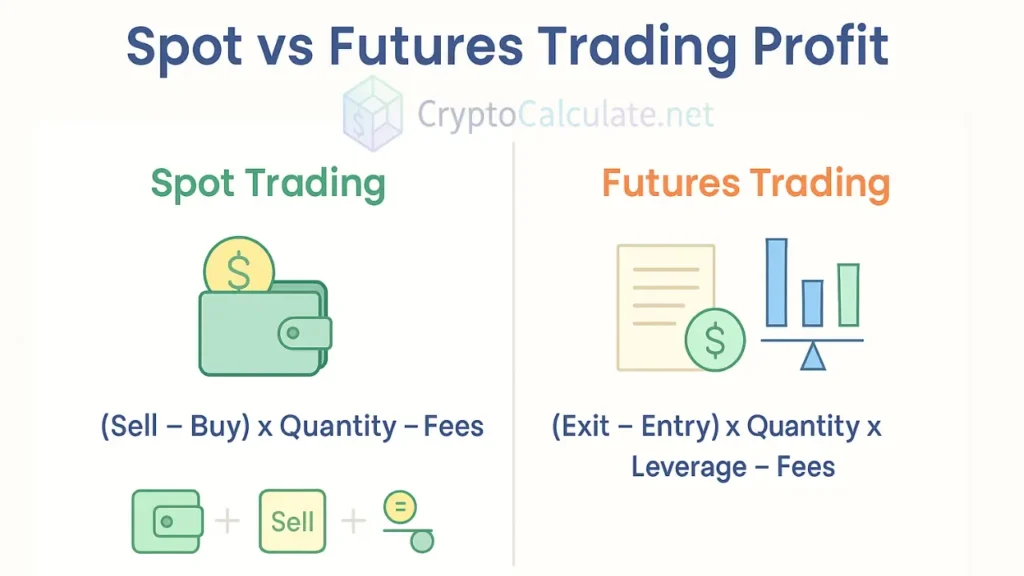
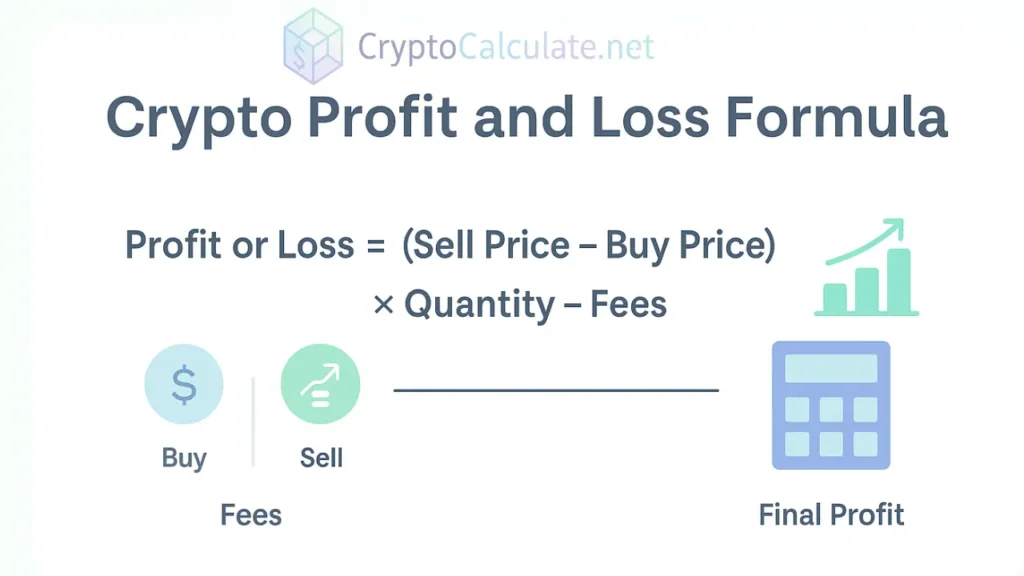
Profit = (Sell Price − Buy Price) × Quantity − Fees
For example:
- Buy 0.1 BTC at $30,000 = $3,000.
- Sell at $35,000 = $3,500.
- Profit = $3,500 − $3,000 = $500 (minus trading fees).
The reason is quite clear. If price rises, you gain. If it falls, you lose.
What Futures Trading Means
In futures, you do not buy the actual coin. You trade contracts that represent the value of coins. You can go long (betting price will rise) or short (betting price will fall). Futures also allow leverage, which means you can open bigger positions with smaller margin money.
How to Calculate Profit in Futures
Formula:
Profit = (Exit Price − Entry Price) × Contract Size × Leverage (if long)
Profit = (Entry Price − Exit Price) × Contract Size × Leverage (if short)
For example:
- You open a long position on 0.1 BTC at $30,000 with 10× leverage.
- If Bitcoin rises to $31,000:
Profit = (31,000 − 30,000) × 0.1 × 10 = $1,000.
Now here’s the thing, with the same movement of $1,000 in price, your futures profit is double or even higher compared to spot. But if Bitcoin falls by $1,000, you lose $1,000 instead. That’s why leverage is double-edged.
Key Differences Between Spot and Futures
| Feature | Spot Trading | Futures Trading |
|---|---|---|
| Asset | Real crypto coin | Contract linked to crypto |
| Ownership | You hold the coin | You do not hold the coin |
| Leverage | Not available | Available, from 2× to 125× |
| Profit Calculation | Based on price difference | Based on contract difference with leverage |
| Risk | Limited to your investment | Higher due to leverage and liquidation |
| Holding Period | No limit | Limited by contract or funding rate |
Now you must have noticed that spot feels safer but slower, while futures move fast but bring higher risk.
Fees and Costs in Spot vs Futures
Spot Trading Costs
- Trading fee (maker or taker).
- Withdrawal fee when moving coins.
Futures Trading Costs
- Trading fee.
- Funding rate (paid every 8 hours usually).
- Liquidation fee if margin drops.
For example, if you hold a futures position for many days, funding payments can eat into your profit. In spot, this does not happen.
Profit in Spot with Real Example
I bought 2 ETH at $1,500 each, total $3,000. After 3 months, ETH price rose to $2,000. I sold for $4,000.
Profit = 4,000 − 3,000 = $1,000.
That’s it. Spot profit is simple. You own, you sell, you gain.
Profit in Futures with Real Example
I opened a 2× leveraged long on 2 ETH at $1,500. Margin used = $3,000.
When ETH rose to $2,000, profit = (2,000 − 1,500) × 2 × 2 = $2,000.
In short time, profit doubled compared to spot. But wait, this matters a lot. If ETH had dropped to $1,250, loss = (1,500 − 1,250) × 2 × 2 = $1,000, with risk of liquidation if margin was too low.
Break-Even in Spot vs Futures
- Spot: Break-even = Buy Price + Fees.
- Futures: Break-even = Entry Price + Fees + Funding Costs.
The thing is that in futures, even if the price stays flat, you may lose money due to funding fees.
Advanced Profit Scenarios
Spot Profit with Staking
If you buy ETH and stake it, rewards increase your final value. Profit = (Sell Price − Buy Price) × Quantity + Rewards − Fees.
Futures Profit with Shorts
If you short Bitcoin at $30,000 and close at $29,000 with 5× leverage: Profit = (30,000 − 29,000) × Quantity × 5.
Hedging Strategy
Some traders hold coins in spot but open opposite futures positions to protect against losses. Profit is calculated by adding both results.
Common Mistakes in Profit Calculation
- Ignoring trading fees.
- Forgetting funding costs in futures.
- Calculating leverage profit without margin risk.
- Mixing spot ROI with futures ROI.
One small mistake many people make is to think 10× leverage means 10× guaranteed profit. But it also means 10× risk.
Spot vs Futures: Which Is Better for You
- Spot: Safer, good for long term holders. You can also transfer coins to wallets.
- Futures: Higher risk, good for short term speculation. You do not own the coin.
Now here’s the thing, you should match your strategy with your risk tolerance.
Tools to Calculate Spot and Futures Profit
- Binance Calculator: Shows profit and liquidation level.
- Bybit PnL Tool: Calculates profit for long and short positions.
- CoinMarketCap ROI Tool: Good for spot holdings.
- Excel/Sheets: You can build custom formulas.
Spot vs Futures in Different Scenarios
- In Bull Market: Spot holders make profit as coins rise steadily. Futures traders can earn more if they go long with leverage, but liquidation risk is higher.
- In Bear Market: Spot holders see losses unless they sell early. Futures traders can profit by shorting, but timing has to be exact.
- For Day Traders: Futures are popular since small moves give large profits. But fees and risk are higher.
- For Long Term Holders: Spot is better. You own the coin, and you can stake or use it in DeFi.
Conclusion
At the end of the day, profit and loss in crypto trading come down to clear calculation and discipline. The market moves fast, but your results depend on how you record every entry and exit. The main thing is to include all costs like trading fees, funding charges, and small network expenses because that is where many traders go wrong.
Spot trading feels steady since you hold real coins, while futures trading works through contracts and leverage. Now here’s the thing, both can be profitable when you understand the math behind them. You should also maintain proper records because it helps in tax reporting, risk control, and future planning.
If you want to track your results accurately, you can use CryptoCalculate.net to check your spot or futures profit easily. The point is simple here, once you learn the right way to calculate profit and loss, you trade with confidence instead of guessing. That is how smart traders think, they calculate first and celebrate later.
FAQs (Frequently Asked Questions)
Q1. Which is safer, spot or futures?
Spot is safer since you own the coin and cannot be liquidated.
Q2. How is profit taxed in spot vs futures?
In most countries both are taxed as capital gains, but rules differ. In India, both fall under 30% flat tax.
Q3. Can I lose more than my investment in futures?
Yes, with high leverage, losses can exceed margin, leading to liquidation.
Q4. Is profit calculation same on all exchanges?
Formulas are same, but fees and funding rules differ.
Q5. Should beginners try futures?
Not really. It is better to start with spot and later move to futures after learning.
Checklist for You
- Always include trading fees in your profit calculation.
- Track funding costs in futures positions.
- Keep leverage low if you are new.
- Use calculators or sheets for accuracy.
- Decide if you want long term safety or short term gains.
- Avoid confusing spot ROI with futures ROI.
At the end of the day, spot profit is clean and stable, while futures profit is sharp and risky. Once you understand the math behind both, you can decide how to balance them in your crypto journey.