
You hear interest numbers in banks all the time, but crypto moves on a different pattern. Your balance grows through compounding, and this growth can run daily or even hourly on some platforms. Now here’s the thing, once you mix yield farming with compounding, returns feel faster, yet the risks rise too since tokens behave in their own way.
You should always understand how compound interest and yield farming ROI work before adding money into these pools. The thing is that these concepts look heavy at first, although they become easier once you see the numbers, tables, and examples lined up in a clear flow.
What Compound Interest Means in Crypto
Compound interest adds earned interest back to your balance at the end of each cycle. When this happens again and again, your amount grows faster because each new cycle uses a slightly bigger number. As we know, this effect stays small in the early months and grows sharply when the balance becomes larger.
You see compound interest in centralized platforms that offer staking and in decentralized protocols that run automated reward cycles. You can check your staking app and notice how the balance rises a little more with each cycle.
How Compound Interest Works
Future Value = Principal × (1 + Rate ÷ n)^(n × t)
Principal is your starting amount. Rate is your annual rate. n is the number of compounding cycles in a year. t tells you the time period. When you plug all these into the formula, you can see how small cycles add up through the full year.
Example of Monthly Compounding
If you stake 1,000 dollars at a 12 percent yearly rate with monthly compounding, the amount becomes around 1,126 dollars after one year. The extra part above 120 dollars comes through compounding. You must have noticed how this difference becomes larger when you stake for more than one year.
Why Compound Interest Matters for You
- You get a steady pattern of growth that rewards long holding.
- You get a clearer view of how staking works across cycles.
- You understand why APY stays higher than APR.
APY already includes compounding, which is why platforms highlight it more than APR.
You can explore the our tool Crypto Profit and ROI Calculator that is built for fast compounding and farming checks.
Yield Farming in Crypto
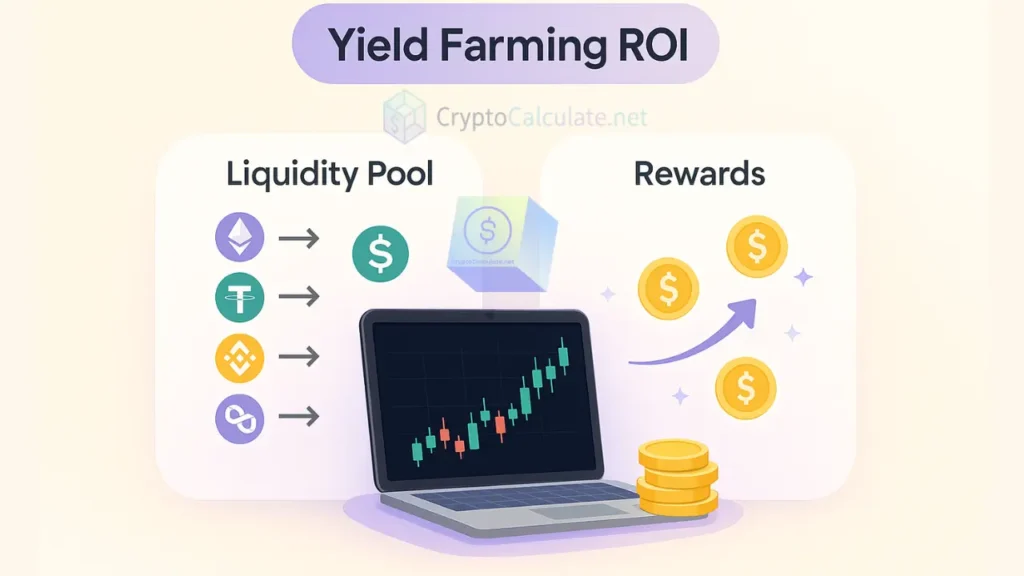
Yield farming is the process where you place your tokens inside a DeFi protocol and earn rewards for supporting liquidity. These protocols run smart contracts that adjust liquidity through automated rules. Your rewards may come in the same token or in a different token depending on the pool.
Now here’s the deal, these platforms may show attractive numbers, although the return changes based on token movement and reward emissions. This is why you should track ROI with care.
How ROI Works in Farming
ROI = (Total Rewards + Final Value − Initial Investment) ÷ Initial Investment × 100
If you place 2,000 dollars in a pool at a 20 percent rate, you may reach around 2,400 dollars after one year. ROI becomes 20 percent. You can reinvest rewards at each cycle, which increases the overall return.
Where You See Yield Farming
You see farming on major AMM platforms like Uniswap, PancakeSwap, SushiSwap, QuickSwap and TraderJoe. You also see it in lending platforms like Aave and Compound where rewards flow through liquidity support.
Compound Interest vs Yield Farming
Compound interest grows through interest that gets added back to your balance. Yield farming grows through rewards that come from liquidity. You already know this, when you reinvest farming rewards into the same pool, the effect becomes compound farming. This speeds up the return if token prices stay steady.
You see a clear difference when you compare APR and APY. APR stays flat. APY shows compounding inside the yearly return.
APR and APY Compared
APR is a flat yearly rate.
APY includes compounding cycles.
APY = (1 + APR ÷ n)^n − 1
This formula helps you compare staking and farming pools across platforms.
Compound Interest Table
| Initial Amount | APR | Compounding | Value After 1 Year |
|---|---|---|---|
| 1,000 dollars | 10 percent | Annually | 1,100 dollars |
| 1,000 dollars | 10 percent | Monthly | 1,105 dollars |
| 1,000 dollars | 10 percent | Daily | Around 1,105.16 dollars |
You can see how daily cycles raise the amount slightly more than monthly cycles.
Yield Farming ROI Table
| Pool | Amount | APR | Rewards After 1 Year | ROI |
|---|---|---|---|---|
| ETH USDT | 2,000 dollars | 15 percent | 300 dollars | 15 percent |
| BNB BUSD | 1,500 dollars | 20 percent | 300 dollars | 20 percent |
| MATIC USDC | 1,000 dollars | 25 percent | 250 dollars | 25 percent |
These values change across chains since token supply, liquidity depth and farming schedules shift throughout the year.
Understanding Impermanent Loss
Impermanent loss happens when token prices inside a liquidity pair move away from each other. The AMM adjusts the balance between the two tokens, which creates a loss when compared to holding each token separately. You see this effect strongly in pools with fast moving tokens or shallow liquidity.
Impermanent Loss Table
| Price Shift | Impermanent Loss |
|---|---|
| 50 percent rise | Around 5.7 percent |
| 2× rise | Around 20 percent |
| 4× rise | Around 42 percent |
This loss becomes noticeable when tokens rise or fall at different speeds.
Compounded Yield Farming ROI
You follow three basic steps when you run a compounded farming cycle.
- You check the yearly rate that the protocol shows.
- You reinvest your farming rewards back into the pool.
- You apply the compound formula with the new balance.
You see automated compounding in platforms like Beefy Finance, Yearn Finance and Autofarm. These vaults harvest and restake your rewards through smart contracts so you get a smooth APY that reflects full compounding.
Entities That Shape ROI
- TVL or total value locked shows the depth of the pool
- Slippage shapes your entry and exit price
- LP tokens show your share inside the pool
- Emission rate controls the flow of reward tokens
- AMM model decides how the pool rebalances amounts
These factors decide how your ROI behaves through the year.
Risks in Yield Farming
- You face impermanent loss when tokens move in different directions.
- You face smart contract bugs when a protocol lacks strong audits.
- You face reward token drops when emission schedules stay high.
- You face high gas fees on chains where network activity stays heavy.
One small mistake many people make is compounding too frequently on high fee chains. Fees cut into the return even when reward numbers grow.
Case Study You Can Relate To
I placed 500 dollars into a Polygon pool at around a 40 percent yearly rate. After six months of steady compounding, the balance touched around 615 dollars. ROI stayed close to 23 percent at that point. When the reward token price dropped later, the overall value fell to nearly 580 dollars.
I thought the return would stay higher, although this one cycle showed me why token behavior shapes the final number. You know what, this lesson stays with me even today when I check farming pools.
Tools to Track Compound ROI and Farming ROI
- DeFi Llama shows APY across many chains
- APY Vision shows compounding with fees
- Zapper displays your DeFi wallet in one place
- CryptoCalculate runs compound interest and farming ROI math
- Custom sheets work for people who track their own cycle length
Now here’s the thing, you should always compare your projected ROI with the actual wallet value so you understand the real growth at each point.
Tax View in Compounding and Farming
Crypto rewards may fall under income rules in some regions. Capital gain rules may apply later when you sell the tokens. You can check local guidelines before planning long cycles so your returns remain clear across the full year.
How to Check a Farming Pool Before Entering
- Check the TVL trend across the week
- Check security audits done by known firms
- Check if tokens in the pair stay stable
- Check gas fees of the chain
- Check reward stability through recent cycles
These checks keep your long cycle steady and predictable.
Common Mistakes You Should Avoid
- Trusting every APY number without checking token behavior
- Skipping gas fee calculations
- Entering low depth pools that react quickly to price changes
- Reinvesting rewards too many times on expensive chains
- Keeping all tokens in one pool without any risk balance
These mistakes reduce final returns even when the screen shows bigger rates.
Checklist for You
- Review APR and APY correctly
- Track gas fees before compounding
- Compare stable pools and volatile pools
- Check protocol audits
- Track ROI at steady intervals
- Reinvest only when the cycle stays profitable
Once you understand how compound interest and yield farming ROI work together, you gain better control over your crypto growth. You can start with a small balance, watch how each cycle behaves, and slowly build a long term plan that fits your comfort level.
FAQs
Q1. What makes compound interest grow faster in crypto
Compound interest grows faster when the platform runs more compounding cycles. You see this in daily or hourly cycles on some staking apps. Growth increases further when your balance becomes larger over time.
Q2. Does yield farming ROI stay steady through the year
Yield farming ROI does not stay steady because token prices move and reward emissions change. You should track the pool once in a while so you know how the value behaves in real time.
Q3. How do I know if a farming pool is safe
You can check if the protocol has a strong audit. You can look at the TVL trend. You can see if the tokens in the pair stay stable. These signals give you a basic picture before entering any pool.
Q4. Can impermanent loss be removed fully
Impermanent loss cannot be removed fully because AMM rules stay the same. You can reduce it by entering pools with stable tokens or tokens that move in a similar pattern. You can also check the liquidity depth before entering.
Q5. Should I calculate my farming ROI in USD or token value
You can check both since token count and USD value may move in different directions. Many traders follow USD value for clarity while tracking token count for long term growth.